Service
Gynecological treatment
HPV Vaccine
1
What is HPV?
Human papillomavirus (HPV) is a DNA virus that can lead to cancer.

(1) Main route of transmission : Sexual intercourse
(2) High-risk types: Over 70% of cervical cancer cases are caused by high-risk HPV types 16 and 18
(3) Lesions : cervical precancerous lesions, cervical cancer, and cancers of the external genitalia (in both males and females)
2
Who is at risk of HPV infection?
Every man and woman has about a 5-8 percent chance of contracting HPV in their lifetime. After women start having sex, the chances of contracting HPV will increase significantly. In addition, complicated partner experiences, long-term low immunity may increase the risk of HPV infection
3
Who should receive the HPV vaccine?
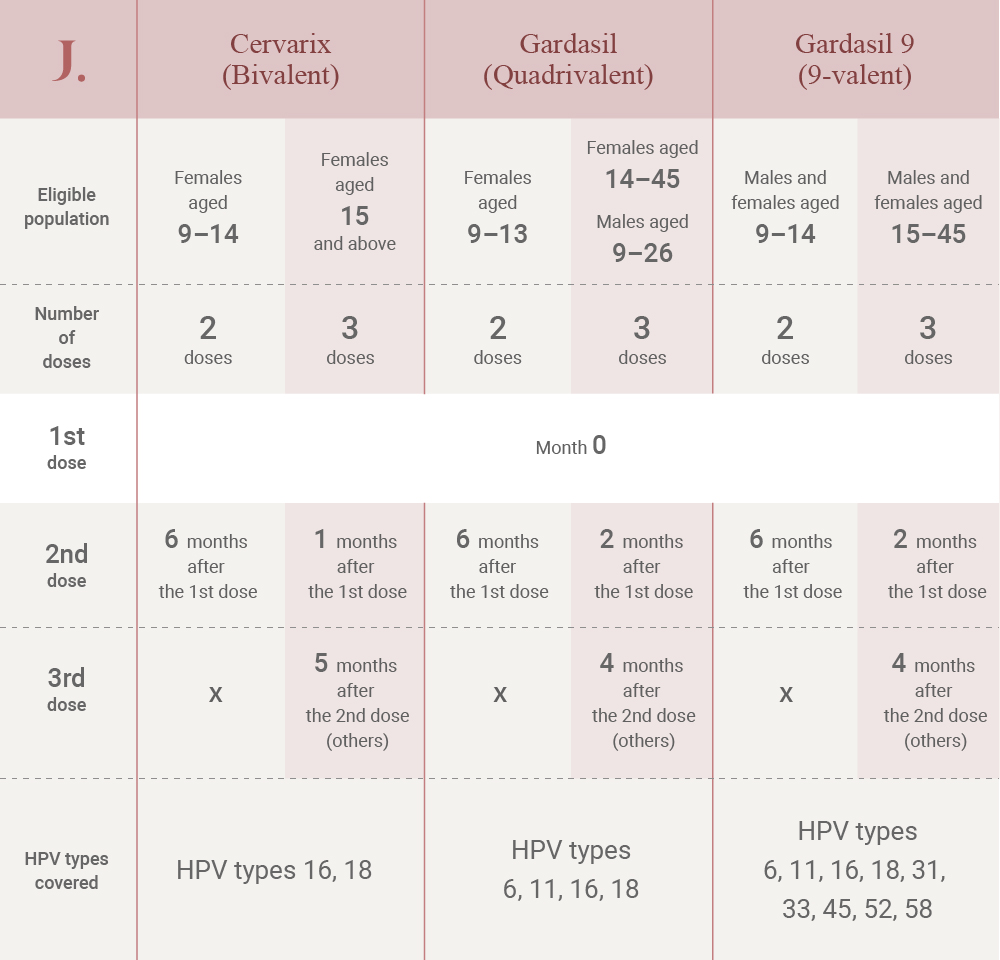
・ The HPV vaccine is most effective for people who are not yet sexually active or who are not infected with HPV; however, those who have experienced sexual behavior can still be vaccinated.
・ The World Health Organization recommends that women aged 9-14 years be the primary target for vaccination and increase vaccination rates, which can reduce the risk of HPV infection in men above 80%. Therefore, the government follows the recommendations of the World Health Organization to provide vaccination services.
・ Non-public reimbursed persons may consult the copy instructions or on the Food and Drug Administration website prior to vaccination.
Introduction to the labia minora
陰部異狀
4
Who is not recommended to get the HPV vaccine?
・ Individuals who have experienced allergic reactions after receiving the HPV vaccine.
・ Pregnant (so far, HPV vaccination has not caused any adverse events to the mother or fetus).
・ Planned pregnancy (pregnancy should be avoided during the six months of vaccination).
・ Individuals with a history of certain medical conditions (e.g., bleeding disorders, immune system abnormalities, or those currently taking immunosuppressive medications).
・ If you have symptoms of fever or infection on the day of vaccination, or are taking medication, you should inform your doctor for evaluation before vaccination.
5
What are the possible side effects of HPV vaccination?
Common Side Effects
Injection site pain, swelling, redness, itching, fever, headache, nausea, dizziness, etc.

Uncommon side effects
Less common side effects.

Internationally, there have been reports of Complex Regional Pain Syndrome (CRPS) and Postural Orthostatic Tachycardia Syndrome (POTS) following HPV vaccination. However, monitoring data from the European Medicines Agency (EMA) show that although reported cases increased after the vaccine was introduced, the incidence of CRPS and POTS in vaccinated individuals is not higher than in control groups.There have been international outbreaks of Complex Regional Pain Syndrome (CRPS) and Postural Orthostatic Tachycardia Syndrome (POTS) following HPV vaccination, but according to monitoring data from the European Medicines Agency (EMA), there is an increase in CRPS and POTS following the introduction of the vaccine. However, CRPS and POTS occurred in the vaccine group The odds are not high compared to the control group.

In Japan, there were reports of chronic pain and other symptoms, but expert committees concluded that these were not related to the vaccine. In 2016, the World Health Organization's Global Advisory Committee on Vaccine Safety (GACVS) reviewed the evidence and determined that HPV vaccines are safe, with no scientific evidence linking them to serious adverse events.

Since 2018, Taiwan's Health Promotion Administration has provided HPV vaccination for junior high school girls and established a reporting system for those receiving subsidized vaccinations. As of the end of May 2023, approximately 617,000 doses had been administered, with 491 reported adverse events (about 0.08%). The most common symptoms were injection site redness, swelling, and pain, followed by fever, dizziness, and headache. Most were mild to moderate and short-lived.
6
Is the HPV vaccine 100% effective in preventing cervical cancer?
Even after vaccination, it is still essential to undergo regular Pap smear screenings. At the same time, practicing safe sex and using condoms are also important measures for preventing cervical cancer.
7
How long does the effectiveness of the HPV vaccine last?
Since the longest follow-up period for study participants is currently about 12 years, it is not yet possible to confirm exactly how long protection lasts after HPV vaccination. Recent data show that: Cervarix (bivalent) provides protection for at least 11 years, Gardasil (quadrivalent) provides protection for at least 12 years, Gardasil (9-valent) provides protection for at least 8 years. However, the duration of long-term protection still requires ongoing observation to be fully determined.
8
After receiving the vaccination, is it necessary to get another dose after several years?
Currently, the longest follow-up period for study participants is about 12 years, so the exact duration of protection after HPV vaccination has not yet been fully confirmed. The latest data show that Cervarix provides protection for at least 11 years, the quadrivalent Gardasil for at least 12 years, and the nine-valent Gardasil for at least 8 years. However, the long-term duration of protection still requires ongoing observation to determine. According to current government-funded vaccination guidelines and package insert recommendations, there is no recommendation to receive a booster dose 5 years after vaccination currently.