Service
Cosmetogynecology
Labia majoraplasty/ Labia majora augmentation
1
Who is suitable for Labia majoraplasty/ Labia majora augmentation?
Labia Majora Atrophy or Laxity:
Due to aging or weight changes, the labia majora may lose elasticity or decrease in volume.

Asymmetric in appearance:
Congenital or acquired factors may cause asymmetry of the labia majora, affecting aesthetic appearance.

Thin Labia Majora:
Individuals who wish to enhance thin or flat labia majora through augmentation procedures to achieve a fuller and more natural look.

Discomfort from Exercise or Friction:
Smaller or thinner labia majora may lead to discomfort or irritation during physical activities or when wearing tight clothing.

Dissatisfaction with Appearance Affecting Confidence:
Those who are unhappy with the appearance of their external genital area, impacting self-confidence or sexual satisfaction.

Postmenopausal Women:
Hormonal changes after menopause may lead to atrophy or dryness of the labia majora, and some may seek procedures for improvement.
2
Issues related to enlarged Labia majora
Some people naturally have more fatty tissue in the labia majora. Weight gain can also lead to extra fat building up in this area, while significant weight loss may cause the skin to become loose or saggy. When wearing tight clothing, this can sometimes create a visible “camel toe” appearance. Friction from walking may also irritate the area, which can lead to chafing, skin irritation, or even darkening over time.
3
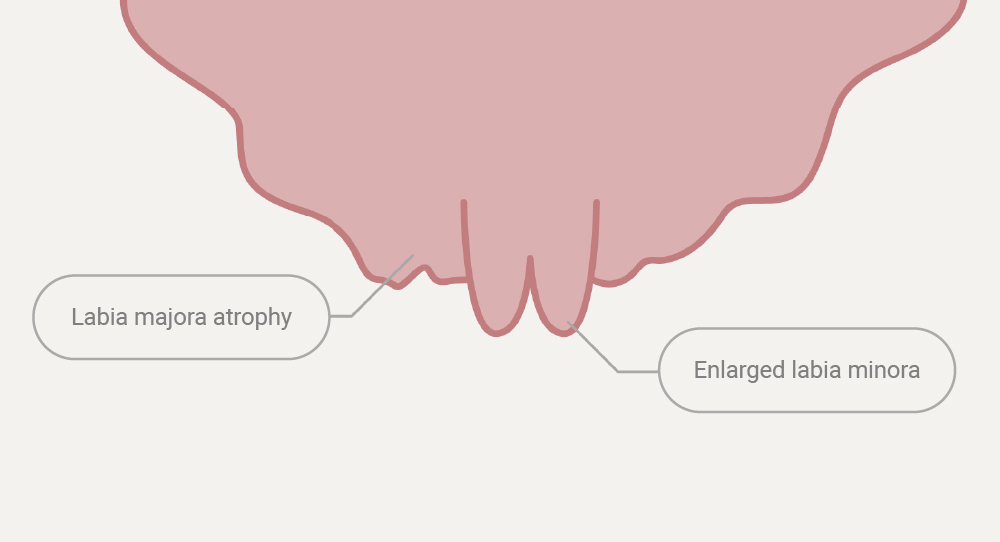
Issues related to labia majora atrophy
After pregnancy, aging, and especially menopause, declining estrogen can lead to loss of collagen, thinner skin, and reduced fat in the area. As the labia majora lose volume, they may no longer fully cover the labia minora, causing a less balanced appearance. The reduced cushioning can also lead to increased friction and discomfort during sexual activity
小陰唇介紹
陰部異狀
4
Introduction to the anatomy of the labia majora
The labia majora are two outer folds of skin extending from the mons pubis to the perineum. They are composed of skin, glands, and fat, typically appearing fuller in the front. Normally, they enclose and protect the labia minora, clitoris, urethral opening, and vaginal opening. During sexual activity, their fat tissue provides cushioning and protection.
5
Labia majoraplasty
By trimming excess tissue of the labia majora and then suturing, this procedure improves concerns such as camel toe appearance, enlarged labia majora, or excessive redundant skin.
6
Labia Majora Augmentation
Lost collagen in the labia majora can be restored using fat transfer or hyaluronic acid fillers, helping to add volume so the labia majora appear fuller and more naturally cover the inner labia minora.
Autologous Fat Grafting
Hyaluronic Acid Filler
Surgical Methods
First draw your own fat, after purification, then fill the labia
Hyaluronic acid filling is injected into the labia, forming a plump shape
Post-operative texture
Autologous fat: natural texture
Hyaluronic acid is a powerful moisturizer, providing a soft texture
Duration of Results
Once the transplanted fat survives in the labia majora, it is less likely to be reabsorbed, resulting in longer-lasting effects
The filler will be gradually absorbed by the body, so the results last a shorter time and require periodic touch-ups
Advantages
✔ Uses natural autologous fat, with a lower risk of rejection

✔Can be combined with liposuction for localized body contouring
✔ No need for fat harvesting; can be directly injected

✔ Procedure is quicker and more convenient
Post-operative Recovery
Redness, swelling, and bruising may occur during the first week after the procedure, and typically subside naturally within a week
Redness and swelling may occur during the first three days, and will gradually resolve within a week